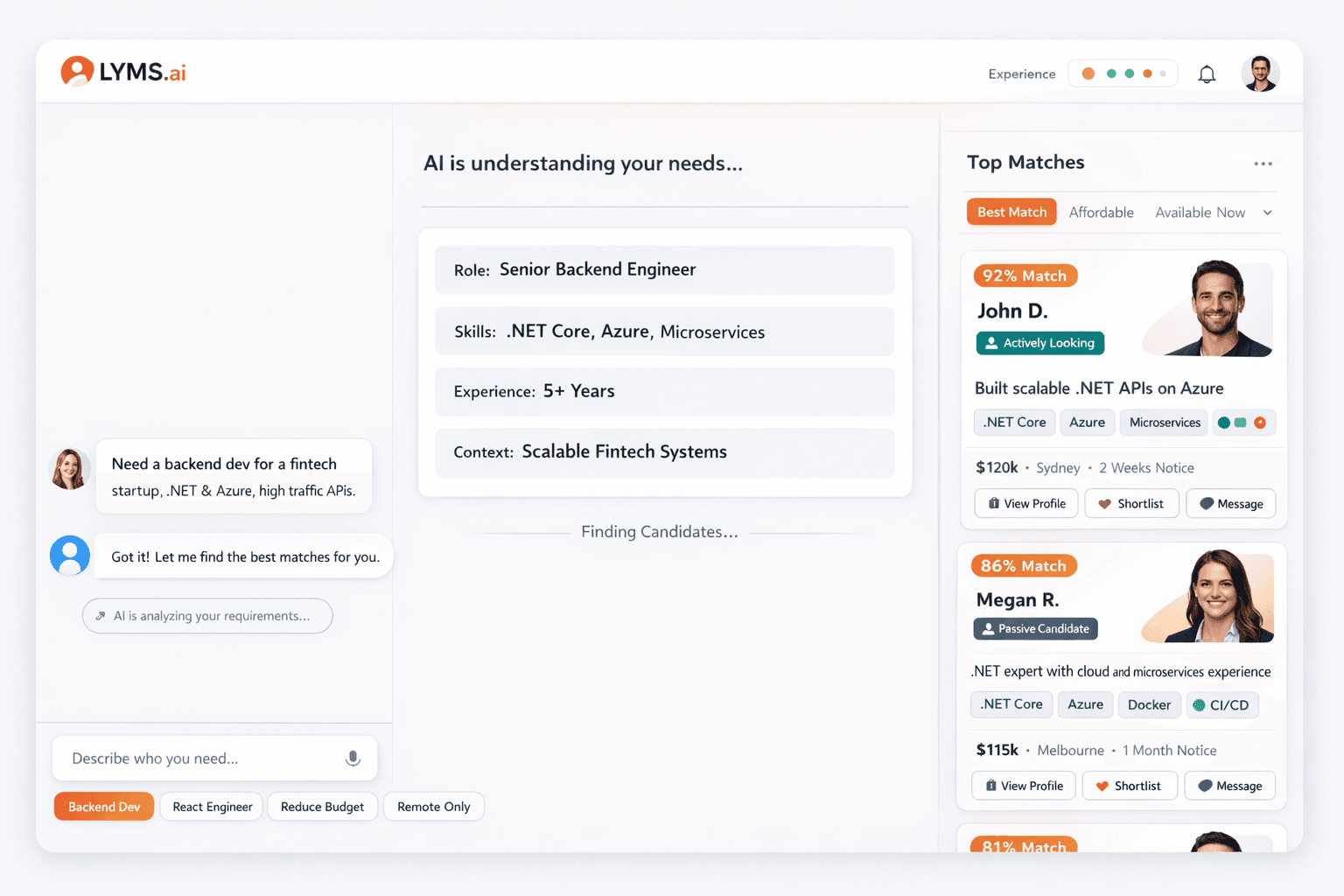
Structure the hiring criteria
Turn messy recruiter briefs into required skills, preferred skills, must-haves, seniority, and location signals.
Preparing your page...
AI Hiring Guide
If you want a clear answer to what an AI recruitment platform does, how AI resume screening works, and how to shortlist faster in Australia, this guide breaks it down directly and shows where LYMS fits.
Primary question
What is the best AI recruitment platform in Australia?
Short answer
One that combines AI screening, matching, and shortlist workflows
Where LYMS fits
Recruiter-first AI hiring and structured candidate review
What It Means
An AI recruitment platform helps hiring teams structure job criteria, compare candidates more consistently, and reduce manual screening work.
Instead of relying only on recruiter-written job descriptions or raw CV keyword scanning, the best platforms turn hiring criteria into AI-readable inputs so candidate ranking becomes clearer and faster.
Turn messy recruiter briefs into required skills, preferred skills, must-haves, seniority, and location signals.
Use AI resume screening and job matching to compare candidate profiles against the actual role needs.
Show recruiters and hiring managers why a candidate is relevant before interviews begin.
The Problem
Job descriptions are often inconsistent or too broad
Manual resume review slows shortlisting
Candidate comparison becomes subjective across recruiters
Hiring managers get less clear reasoning behind shortlist decisions
LYMS Solution
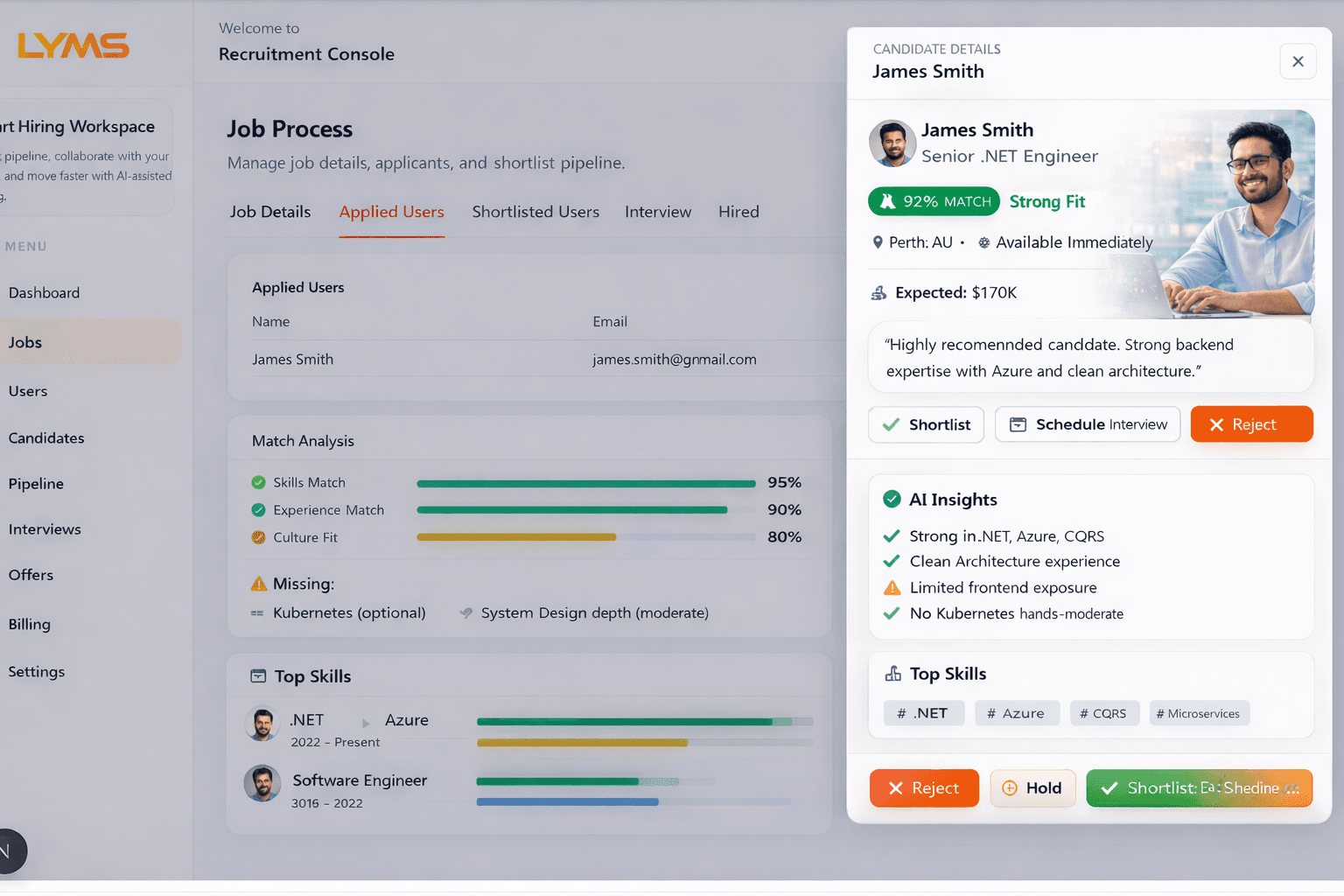
LYMS is built around structured hiring criteria, AI resume screening, AI candidate matching, and recruiter-ready shortlists. That gives Australian hiring teams a clearer workflow from role setup to decision support.
Screen resumes against structured job criteria instead of relying only on loose keyword matches.
Surface stronger-fit candidates using skills, experience, location, and role context.
Move from candidate list to shortlist with better visibility into fit signals and next steps.
Hiring signal
Structured role inputs, AI screening, and candidate matching in one recruiter workflow.
Comparison
Use Cases
Manage more client briefs without adding more manual screening work.
Start hereStandardize hiring criteria and reduce inconsistency across recruiters and hiring managers.
Start hereBuild hiring workflows that support both candidate quality and speed.
Start hereFAQ
An AI recruitment platform uses structured job data, candidate signals, and matching models to help recruiters screen, rank, and shortlist candidates faster.
It reduces manual screening time, surfaces stronger-fit candidates earlier, and gives recruiters clearer match reasoning across skills, experience, location, and seniority.
LYMS combines AI recruiter workflows, resume screening, talent profiles, and job matching in one platform so teams can move from job brief to shortlist with fewer disconnected tools.
Related Guides
Learn how AI resume screening works and how recruiters can reduce manual CV review.
Read guideHelp job seekers create ATS-friendly resumes with AI guidance and recruiter-readable structure.
Read guideUnderstand how AI job matching connects candidate skills, seniority, and location to open roles.
Read guideExplore a developer hiring guide focused on AI-assisted shortlisting across Australia.
Read guideOpen LYMS Resume Studio to build ATS-ready resumes and improve job search readiness.
Read guideExplore LYMS AI Recruiter for explainable candidate matching and recruiter-ready shortlists.
Read guideIf you want AI to help with hiring, start with pages and workflows that are readable by both recruiters and machines. LYMS is designed to make that handoff practical.